
Every few weeks someone messages our workshop with a version of the same worry: “I want to gift a Lakshmi murti for my sister's new flat, but my aunt says giving idols is inauspicious.” It is worth answering properly, because the anxiety is modern and the custom is not.
Where the custom comes from
Gifting murtis is woven through Indian household practice. A murti is given at griha pravesh so the new home has a deity from day one; at weddings so the new household begins with a mandir; at Diwali and Dhanteras because bringing Lakshmi home is the meaning of the festival. In each case the gift is understood as daan — an offering that carries merit for the giver — rather than as a transaction.
Is it bad luck to give someone a god idol?
No, and it is worth naming where that idea comes from, because it is a garbled version of a real rule. Tradition does say a broken, chipped or cracked murti should not be worshipped, and by extension should not be passed to someone else. Somewhere in retelling, “don't give a damaged murti” lost its adjective. Inspect the piece before you wrap it and the entire superstition evaporates.
The rule was never “don't give an idol”. It was “don't give a broken one”.
Which murtis should you not gift?
A short and practical list, drawn from what families actually observe:
| Avoid gifting | Why |
|---|---|
| Chipped, cracked or repaired murtis | The one genuine prohibition — a damaged murti is retired, not re-gifted |
| Fierce (ugra) forms of deities | Traditionally installed in temples with specific rites, not in home mandirs |
| Nataraja for a home mandir | Widely treated as a temple and performance-hall form rather than a household one |
| Very large temple-scale idols | A gift the family has nowhere to place is a burden, however generous |
| A deity the household doesn't worship | Gift what they will actually pray to, not what you prefer |
What makes a good murti gift
- Right-sized for their mandir, not your budget. A 6-inch murti fits a shelf mandir; an 11-inch needs a pooja room. Our size guide has the measurements.
- A deity they already keep. Lakshmi and Ganesha are near-universally welcome; beyond those, ask someone in the family.
- Handmade over moulded. The point of the gift is care. A hand-finished piece shows it, and it lasts long enough to be remembered.
- Presented in person. Where distance makes that impossible, we ship with a printed card — but hand it over yourself if you can.
The pieces families gift most
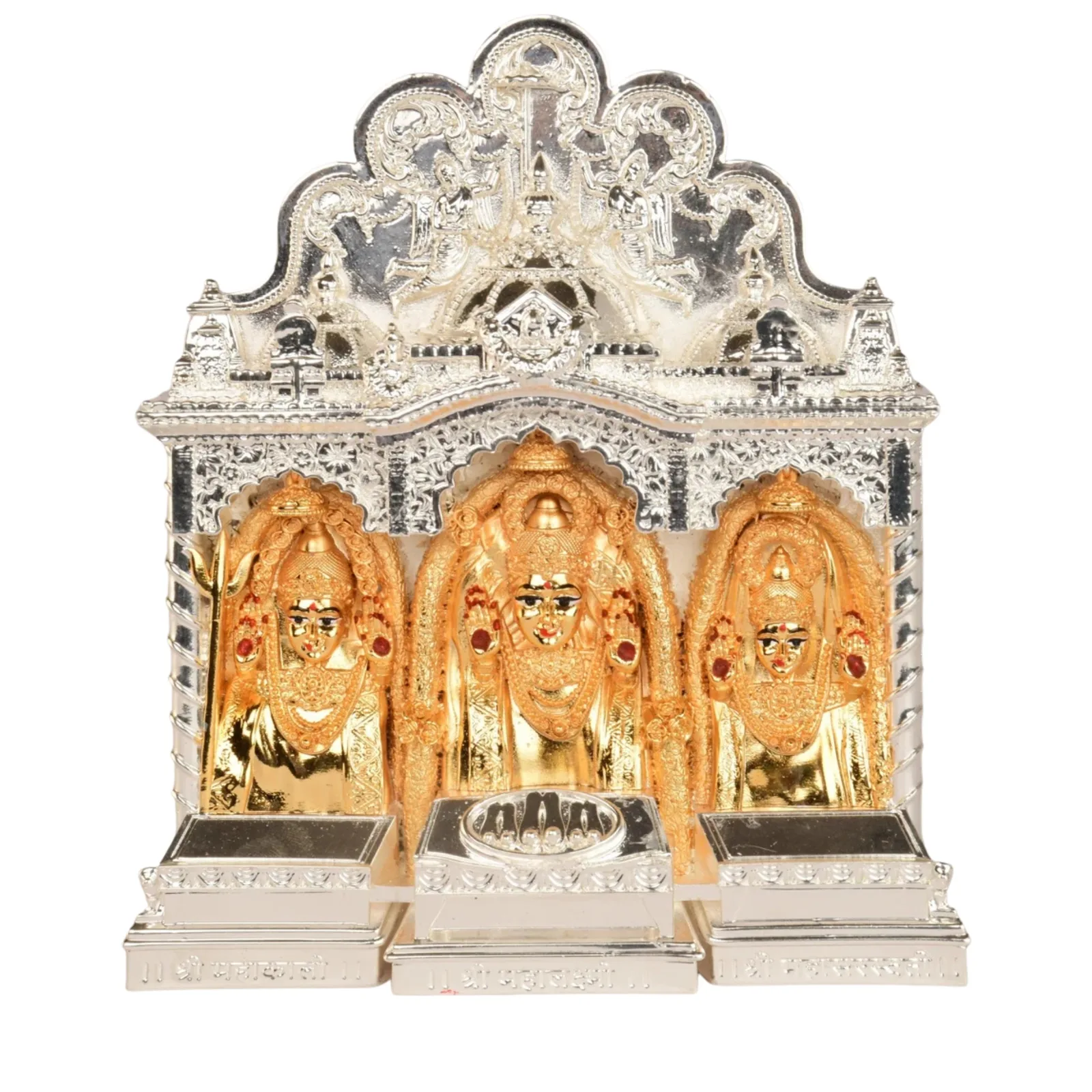
For housewarmings and wedding return gifts, the 6-inch hand-painted Mahalaxmi (₹1,999) is far and away the most-ordered piece from our workshop — modest, complete and clearly handmade. For a milestone gift meant to last generations, families choose the pure gold and silver plated Mahalaxmi (₹17,000). And for a Mumbaikar, the Mumba Devi murti is a gift no one else can give — nobody else makes one.
If you are buying several, our gifting page covers bulk pricing, custom packaging and shipping to individual addresses.