
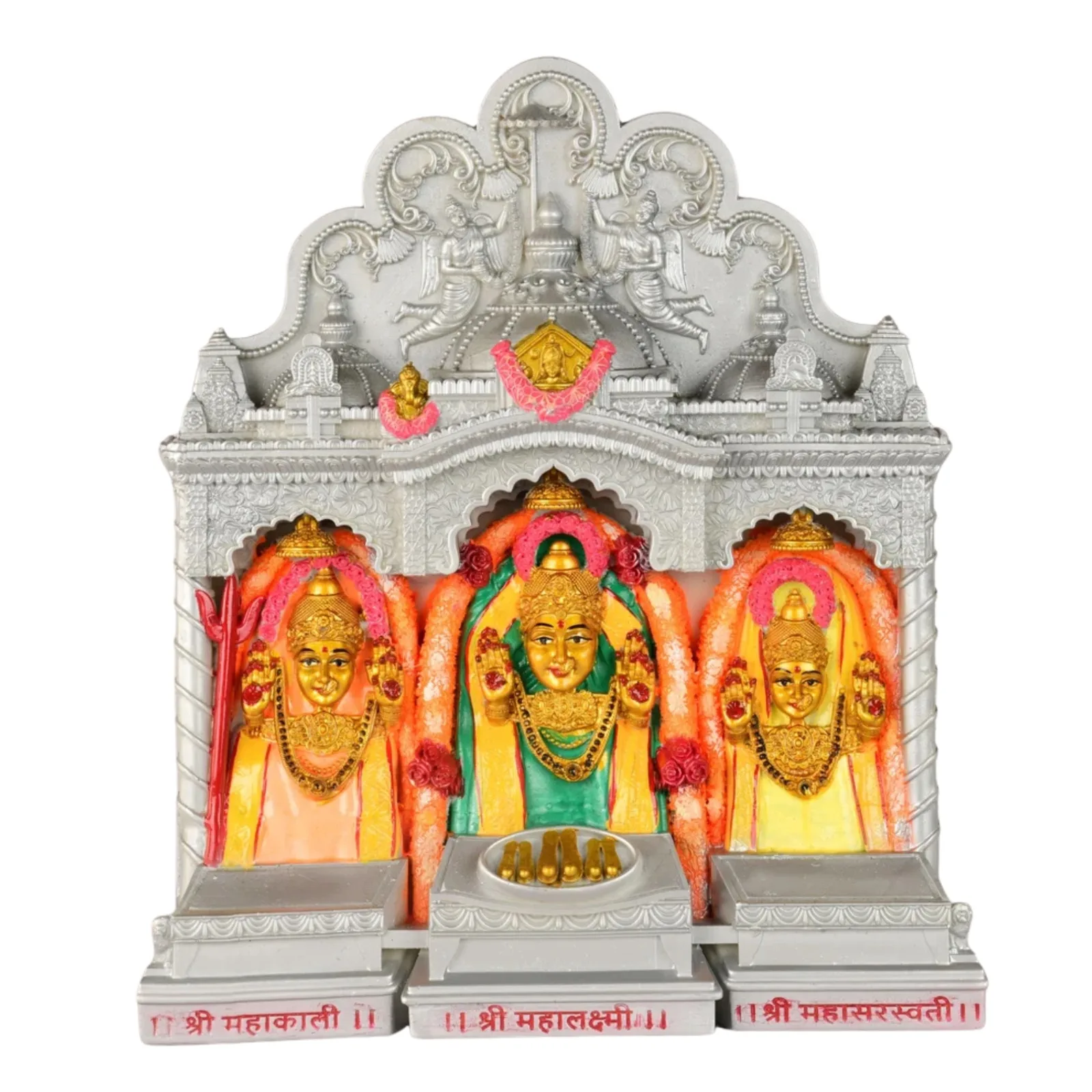
This is the single most common question we get before a Diwali order, and it usually arrives with a note of worry attached — someone has read a list online that says a standing Lakshmi at home brings instability. Here is the tradition as it is actually taught, without the fear.
What the two forms mean
Lakshmi is described in many forms, and two of them dominate household iconography:
| Seated (sthir) Lakshmi | Standing (chanchal) Lakshmi | |
|---|---|---|
| Signifies | Settled, stable, resident prosperity | Active, flowing, circulating abundance |
| Traditional setting | Home mandir, family pooja room | Temples, shops, offices, business premises |
| Posture | On a lotus, often with abhaya and varada mudra | Upright on a lotus, coins often shown flowing |
| Common pairing | With Ganesha for Diwali puja | Alone, or as a temple utsav murti |
| Everyday reading | “May prosperity settle here” | “May prosperity keep moving through here” |
Why homes are advised to keep a seated Lakshmi
The logic is a metaphor, and a rather beautiful one. A household wants wealth that stays — a stable foundation, reserves, security for the next generation. A business wants wealth that moves — turnover, circulation, trade. Sitting and standing are how the iconography says that. This is why almost every family mandir in India holds a seated Lakshmi, and why the Lakshmi in a jeweller's shop is often standing.
That is the whole of it. There is no scriptural injunction, no punishment, no ruin attached to a standing murti in a house — only a long-standing preference with a sensible symbolic reason behind it.
Iconography is a language, not a law. Sitting says “settle here”; standing says “keep flowing”. Both are prayers.
What if you already own a standing Lakshmi?
Then worship her. This is the part the internet lists leave out. A murti that has been installed, prayed to, and cared for is not downgraded by a preference. If you would still like a seated murti at the centre of your mandir, the gentlest options are:
- Keep both. Place the seated Lakshmi at the centre and the standing form beside her. Nothing in tradition objects.
- Move, don't discard. A standing Lakshmi is well suited to a shop, office or study — the settings the form was made for.
- Retire respectfully. If a murti is damaged or you are letting it go, immerse it in flowing water or hand it to a temple or family who will worship it. Never household waste.
There is a third form: the temple shrine
Sitting and standing are not the only two options, and the one most households actually grow up with rarely gets mentioned online — the temple-shrine murti, where the deity is sculpted as she is enshrined in her temple, inside a carved sanctum with her attendant goddesses, rather than as a single free-standing figure.
This is the form we sculpt. Our Mahalaxmi murtis show Mahalaxmi at the centre with Mahakali and Mahasaraswati in their own arched niches, beneath a silver-worked temple canopy with domes — the three-goddess darshan Maharashtrian families know from the temple itself. For many households that is the more meaningful piece: you are not bringing home an icon of the goddess, you are bringing home her sanctum.
If you specifically want a single seated Lakshmi on a lotus, tell us — custom work is what our Mumbai workshop does, and we will sculpt one to your size and finish.
Choosing your murti
Once the form is settled, the practical decisions are size and material: a 6-inch marble dust Mahalaxmi (₹1,999) for a shelf or compact mandir, the 11-inch (₹2,999) for a dedicated pooja room, or the pure gold and silver plated 11-inch as a Diwali and heirloom centrepiece. Our size guide has a measuring chart, and the price guide lays out what each tier costs.
Once you have chosen the murti, the next question is where she faces — answered in our guide to Lakshmi idol direction.