
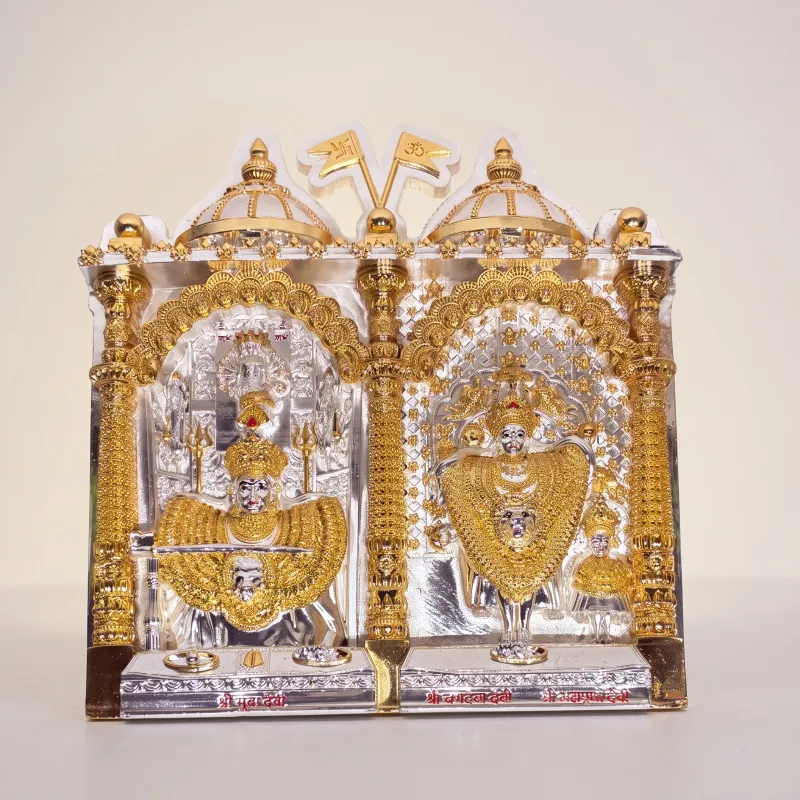
We make marble dust murtis for a living, so let us start by saying what most sellers won't: marble dust is not solid Makrana marble, and anyone selling it as such is misleading you. It is its own material, with its own genuine strengths and its own limits. If you are comparing a ₹2,500 marble-dust Lakshmi with a ₹25,000 carved-marble one, you deserve a straight explanation of the difference.
What is a marble dust murti?
Natural marble is ground to a fine powder, blended with a resin binder, and shaped — cast in a master mould or sculpted, then hand-finished, hand-painted and sealed. The result has the cool, smooth surface feel of stone, crisp detailing, and roughly a third of the weight of solid marble. Because it isn't carved from a block, intricate forms (like our twin-dome Mumba Devi sanctum) are achievable at prices a hand-carved equivalent never could be.
Marble dust vs marble vs resin vs brass — the honest comparison
| Marble Dust | Solid Marble | Plain Resin | Brass | |
|---|---|---|---|---|
| Typical price (9–12″ murti) | ₹1,500–4,000 | ₹15,000–1,00,000+ | ₹500–2,000 | ₹5,000–30,000 |
| Look & feel | Smooth, stone-like, holds vivid hand-painted colour | Unmatched depth; carved detail | Lightweight, can look plasticky | Metallic lustre, traditional weight |
| Weight | Moderate (our 11″ ≈ 2.4 kg) | Heavy | Very light | Heavy |
| Durability | Very good; sealed against water; can chip if dropped | Generations; can crack on impact | Fades and scratches | Generations; needs polishing |
| Daily abhishek | Yes, with waterproof coating | Yes | Usually not colour-fast | Yes |
| Best for | Home mandirs, gifting, detailed painted forms | Temples, heirloom commissions | Décor, car dashboards | Traditionalists, South Indian style worship |
The summary we give our own relatives: if the budget allows hand-carved Makrana marble from a good sculptor, it is a magnificent thing. For everyone else — which is most homes — a well-made, well-sealed marble dust murti gives you 90% of the beauty at 10–20% of the price, with colour and detail solid marble can't take.
Are marble dust statues good for a home temple?
Yes — and it is worth addressing the criticism directly, because some pure-marble sellers claim marble-dust murtis are "fake", lack prana, or are unfit for worship. Here is the honest position:
- On authenticity: marble dust is real, ground natural marble. What would be fake is calling it solid carved marble — which we never do, and you should walk away from any seller who does.
- On worship: across India, home mandirs hold murtis of clay, wood, metal, stone and painted plaster. The shastric emphasis for household worship is on shraddha — devotion, cleanliness and regularity — not on the market price of the material. Families have worshipped painted murtis of exactly this kind for generations.
- On pran pratishtha: for formal temple consecration, traditions do specify materials and measurements — that is a decision for your acharya, and for temple commissions we advise asking them first. For daily home worship, no such bar exists in common practice.
Why ours are waterproof (and why that matters)
The traditional weakness of painted murtis is water: tilak, panchamrit and jal-abhishek slowly lift the colour. Every Vishnupriya Arts marble-dust murti is sealed with a plastic-coated, 100% waterproof finish after hand-painting — the colours are locked beneath the seal, so daily rituals leave no mark. It is the single biggest reason our murtis stay vivid for years, and few makers bother to do it.
How to spot a well-made marble dust murti
- Weight test: it should feel substantial — suspiciously light usually means plain hollow resin, not marble dust.
- Face and fingers: hand-finished pieces have crisp eyes, lips and finger detailing; blurred features mean a tired mould and no hand-finishing.
- Paint edges: look where colours meet — clean edges are the signature of hand-painting.
- Sealed surface: ask if it is waterproof. If the seller hesitates, the paint is exposed.
- Honest labelling: the listing should say marble dust (or "cultured marble"), never just "marble".
Caring for your marble dust murti
Dust with a soft dry cloth or brush; a lightly damp cloth is fine on our waterproof finish. Avoid harsh chemicals, abrasives and long direct sunlight. Handle by the base, not the crown or hands. That is genuinely all — see each product page for piece-specific care notes.
See the material for yourself
Our 6-inch (₹1,999) and 11-inch (₹2,999) Shree Mahalaxmi murtis and the Mumba Devi temple murti (₹2,499) are all hand-painted marble dust with the waterproof seal — photographed exactly as they ship. Or read how a murti is made in our workshop, from raw powder to final varnish.